
Electric cars and hybrids have sophisticated batteries, advanced software, and efficient drivetrains. Yet a surprisingly ordinary component can still leave drivers stranded: the 12-volt auxiliary battery. Even when the large battery used to power an electric motor has plenty of energy, a failing low-voltage system may prevent the vehicle from starting or entering its ready-to-drive mode.
12V battery problems in hybrid and electric cars deserve attention in 2026. A May 2026 Which? survey report found that owners of certain newer electrified vehicles reported unexpected auxiliary-battery faults. Here is what the smaller battery does, how to recognize trouble, and what to ask a repair technician to check.
Why 12V Battery Problems Are Making News in 2026
The UK consumer organization Which? surveyed more than 63,000 car owners in 2025 and published its findings in May 2026. Among vehicles less than four years old, approximately 5.5% of full-hybrid owners reported a flat or failed 12V battery in the survey period, compared with 1.4% of gasoline-car owners. The reported rates were 3.8% for fully electric vehicles and 3.5% for plug-in hybrids.
These are owner-reported UK survey results, not failure rates for every model or for the entire United States. Still, they highlight a useful lesson: a newer, technologically advanced car is not immune to low-voltage electrical trouble.

What Does a 12V Battery Do in an EV or Hybrid?
Most electrified vehicles have two different electrical systems. The high-voltage traction battery supplies energy to the electric drive motor. The smaller 12V battery typically powers computers, control modules, locks, lighting, and other low-voltage equipment. It can also help energize the electronics that connect the high-voltage system when the vehicle is switched on.
Unlike a conventional gasoline vehicle, many hybrids and EVs do not use a normal alternator to recharge the 12V system. A DC-DC converter can step energy down from the high-voltage battery to support low-voltage equipment. The National Highway Traffic Safety Administration explains this distinction and why servicing high-voltage components requires specialized training.
For an accessible comparison of the two batteries, see AAA’s hybrid ownership questions and NAPA’s guide to auxiliary batteries.
Why Can a Fully Charged EV Still Fail to Start?
A dashboard may show ample traction-battery charge while the car refuses to enter its READY mode. That can happen when a weak 12V supply cannot reliably activate the computers, relays, or other equipment needed to make the vehicle operational. The exact behavior varies by make and model.
The issue is not always a defective battery. An electrical load while parked, a charging-system fault, damaged wiring, or a module that fails to enter sleep mode could also drain a healthy auxiliary battery. That is why diagnosing the whole low-voltage system matters more than simply swapping the battery.
Five Warning Signs of a Weak 12V Battery
1. The vehicle will not enter READY mode
You may hear clicking, see brief dashboard illumination, or experience a completely unresponsive start button. Unlike a conventional gasoline car, some hybrids will not exhibit the familiar slow engine cranking associated with a dead battery.
2. Screens and lights behave unpredictably
Flickering displays, repeated system restarts, dim interior lights, or unusual warning messages can accompany unstable low-voltage power. These symptoms may also have other causes, so testing is important.
3. Door locks or remote access become unreliable
Power locks, vehicle modules, and connected systems rely on electricity. A weakening battery may contribute to access problems, although a failing key-fob battery is a separate possibility.
4. The battery goes flat after parking
A car that repeatedly fails after sitting overnight or for several days could have a battery with reduced capacity, excessive standby power consumption, or a charging-system problem.
5. Multiple electronic alerts appear together
Low supply voltage can sometimes cause several modules to report faults at once. Never assume every warning is harmless, particularly those involving brakes, steering, or the hybrid system. Follow the owner’s manual and seek prompt inspection for serious alerts.
For broader warning signs, see Guarantee Automotive’s existing guide on when a car battery may need replacement.
What Causes Auxiliary-Battery Failure?
Several different problems can produce the same no-start symptom. Age, prolonged parking, extreme temperatures, frequent short trips, accessories left active, poor connections, and an internal battery defect can all be factors. Modern vehicles also contain networked electronics that may draw unexpected current if a component fails to shut down properly.
A battery’s design matters, too. Some vehicles use conventional lead-acid batteries; others require AGM, EFB, or model-specific lithium-based low-voltage batteries. The July 2026 SAE J3012 revision addresses performance testing for lead-acid batteries designed for start-stop operation, illustrating why low-voltage battery requirements are not identical across vehicle types.
Using the wrong replacement chemistry, size, or specification may create additional problems. Some vehicles also require electronic battery registration or programming after replacement.
How a Professional Diagnoses the Problem
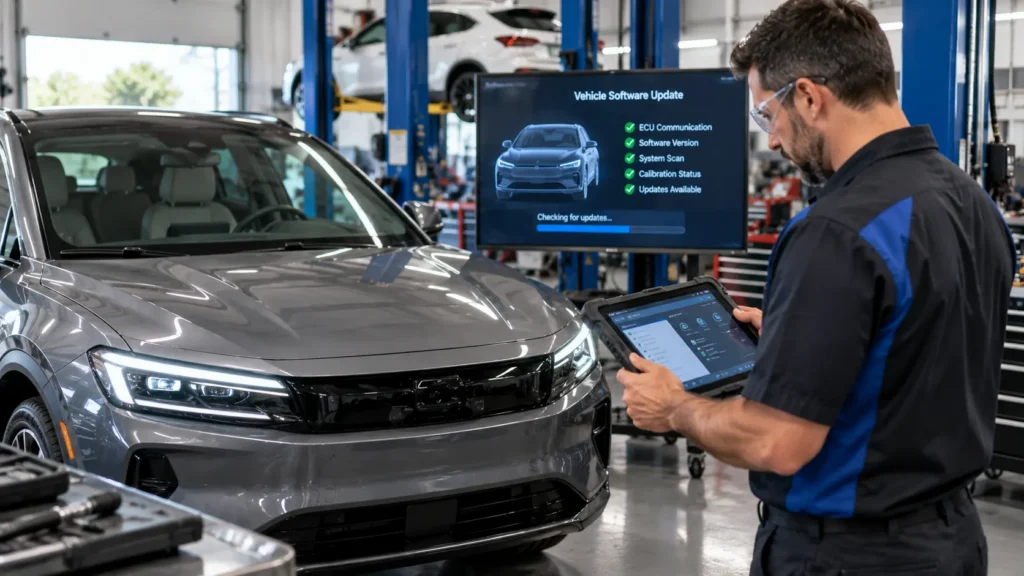
A good diagnosis begins with the vehicle’s symptoms and service history. The technician can inspect accessible terminals and wiring, measure the battery’s condition using a compatible tester, check charging behavior, and scan the vehicle for stored fault codes. Depending on the symptoms, further testing may be needed for parasitic current draw or the DC-DC charging system.
Battery voltage alone is not a complete health assessment. A battery may show a seemingly normal resting voltage but perform poorly under load. Conversely, a low reading may reflect a charging problem rather than a worn-out battery.
Modern vehicles increasingly require appropriate scan tools for tasks such as battery registration and electrical-system diagnosis. For context, Snap-on’s technical guide to scan tools explains why routine maintenance now involves more vehicle electronics.
Can You Jump-Start a Hybrid or Electric Car?
Sometimes, but the procedure is vehicle-specific. NHTSA’s EV and hybrid guidance states that the high-voltage traction battery must not be jump-started. Many models allow assistance to the 12V system using designated terminals and a specified method.
Check the exact owner’s manual before attempting any jump-start. Never connect jump leads to orange high-voltage cables or improvise a connection point. Some hybrid models also must not be used to jump-start another vehicle. If you are unsure, request roadside assistance familiar with your vehicle.
If the vehicle starts after assistance, do not assume the problem is solved. Repeated jump-starts are a reason to test battery condition, charging performance, and parked electrical draw.
How to Reduce the Risk of a Dead 12V Battery
- Follow the manual: Observe manufacturer instructions for storage, battery charging, and maintenance.
- Limit unnecessary standby loads: Avoid leaving aftermarket accessories running while parked.
- Check for software or recall notices: Some electrical issues have model-specific service solutions.
- Test the battery when symptoms appear: Repeated no-start events should prompt diagnosis rather than guesswork.
- Use a compatible replacement: Match the specified battery type and required electronic setup.
- Investigate repeat failures: A new battery will not fix an unresolved charging or parasitic-draw fault.
Check your VIN using the NHTSA recall lookup. Owners who notice other EV battery symptoms can also read Guarantee Automotive’s article on when an electric vehicle needs a battery check.
Frequently Asked Questions
Is the 12V battery the same as the hybrid battery?
No. The auxiliary battery supports low-voltage electronics, while the high-voltage traction battery powers electric propulsion. Their designs and service procedures differ.
Will replacing the 12V battery fix every no-start problem?
No. Charging faults, wiring issues, software behavior, or a module drawing power while parked may also be responsible. Diagnosis should come first.
Can an EV have a dead 12V battery while plugged into a charger?
Yes, depending on the vehicle’s design and the nature of the fault. Plugging in the traction battery does not guarantee that a defective low-voltage system will recover.
Final Thoughts
The latest 2026 findings are a reminder that advanced vehicles still depend on basic electrical reliability. A healthy traction battery does not rule out a weak auxiliary battery, and the right repair may involve testing battery health, charging operation, wiring, or software rather than immediately replacing components.
For more practical guidance, explore Guarantee Automotive’s modern vehicle electronics troubleshooting article or browse the automotive maintenance blog. When arranging service, confirm that the repair facility has the appropriate diagnostic equipment and training for your vehicle’s electrical system.